Key Ground Risks Addressed by Geotechnical Engineering
Geotechnical engineering focuses on identifying and managing the following risks:
-
variable soil conditions across a site
-
settlement and ground movement
-
groundwater presence and fluctuation
-
contamination and ground gas
-
slope instability and embankment risk
-
made ground and historic fill
-
construction sequencing risk
Each of these factors can affect design assumptions and construction outcomes.
Understanding Soil and Ground Conditions
Soil and ground conditions vary significantly, even across small distances. Adjacent sites can behave differently due to changes in geology, historic land use, and groundwater conditions. This variability explains why nearby data cannot always be relied upon.
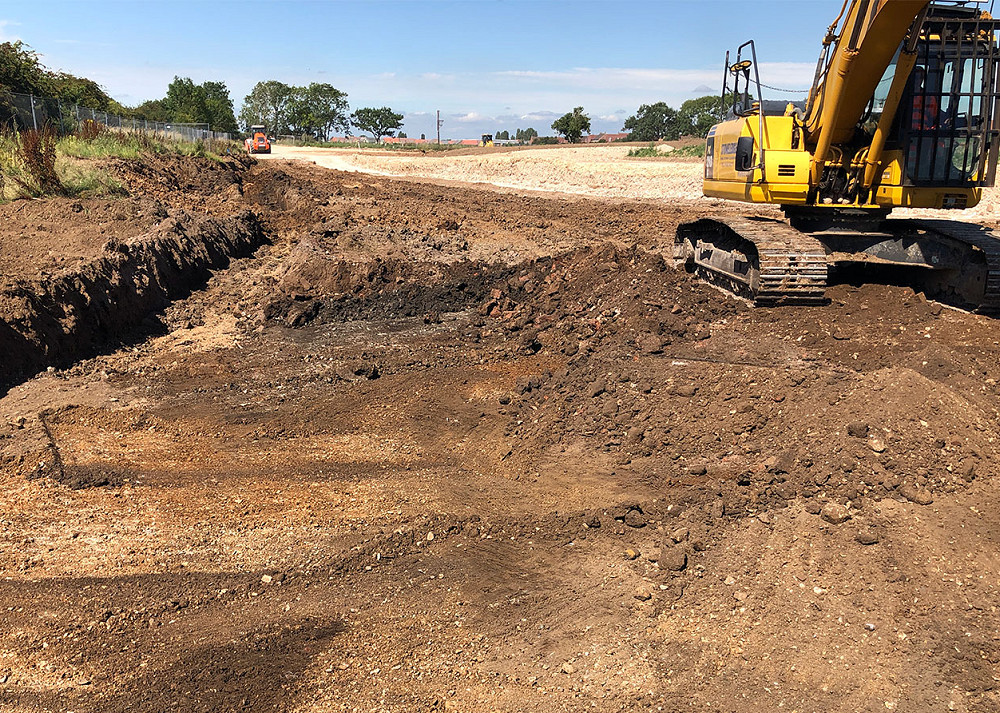
Ground profiles often include natural strata overlain by made ground from previous development. Made ground can contain variable materials that behave unpredictably under load. Groundwater adds further complexity by influencing strength, excavation stability, and long-term performance.
Geotechnical engineering brings these factors together to form a realistic picture of how the ground will behave during and after construction.
What Ground Risk Means in Practice
Ground risk describes the likelihood that soil behaviour will affect a project’s safety, cost, or programme. It is not limited to structural failure. Differential settlement, excessive movement, and unstable excavations can all disrupt construction and operation.
For example, compressible soils can cause settlement that damages finishes or services. Shrink–swell clay can lead to seasonal movement affecting shallow foundations. Ground risk links soil behaviour directly to structural performance and buildability.
Understanding cause and effect allows risk to be managed rather than discovered late.
Soil Investigation and Testing
Soil investigation underpins geotechnical decision-making. Without site-specific information, design relies on assumptions that may not reflect reality. Investigation reduces uncertainty by confirming soil type, strength, and groundwater conditions.
A soil investigation may include intrusive techniques such as boreholes or trial pits, supported by laboratory testing. Non-intrusive methods can provide additional context where access is limited. The level of investigation should reflect project scale and risk.
Data from investigation feeds directly into the geotechnical report, which records findings, assumptions, and limitations.
Foundations and Ground Interaction
Foundations transfer loads from a structure into the ground. Their performance depends on bearing capacity, settlement behaviour, and interaction with groundwater. Foundation selection therefore responds to ground conditions rather than architectural preference.
Shallow foundations rely on near-surface soils with adequate strength and limited movement. Deep foundations transfer load to deeper, more competent strata where surface soils are weak or variable. Each approach carries different cost, programme, and construction implications.
Foundation design aligns structural demand with ground response to achieve stability and serviceability.
Reducing Ground Risk Through Early Input
Early geotechnical input reduces risk by aligning investigation, design, and construction planning. Delayed assessment often leads to redesign or mitigation under time pressure.
- carry out investigation early to inform assumptions
- match foundation selection to confirmed ground conditions
- identify mitigation measures before construction begins
- coordinate geotechnical input with structural and civil design
- plan construction sequencing around ground constraints
These steps improve predictability and reduce avoidable disruption.
Residential, Commercial, and Infrastructure Contexts
Ground risk affects all project types but scales differently. Residential projects often focus on shallow foundations, drainage interaction, and long-term movement affecting dwellings. Commercial developments introduce higher loads and greater tolerance requirements.
Infrastructure projects face larger footprints, variable ground profiles, and greater consequence of failure. In all cases, geotechnical input supports proportionate decision-making based on risk rather than size alone.
The principles remain consistent, even as complexity increases.
Common Misconceptions About Ground Conditions
One misconception is that ground that appears stable at the surface presents low risk. Many issues arise below ground level. Another is that nearby site data is sufficient. Local variation often invalidates this assumption.
A further myth is that foundations solve all problems. Foundations respond to ground behaviour but do not remove it. Without understanding ground risk, foundation solutions may simply transfer problems elsewhere.
Clear assessment replaces assumption with evidence.
Final Considerations
Understanding soil behaviour and ground risk is essential to safe and predictable construction. Geotechnical engineering links investigation data to foundation decisions, reducing uncertainty and supporting informed project choices. Early, proportionate input allows risks to be managed before they affect cost, programme, or performance.
Related guidance is available on site investigations, foundation design, and structural coordination, which together support effective ground-led decision-making.